




Dr. Phil Zeltzman’s Blog
Notes from a physical therapy conference in South Africa
I was very fortunate to attend the 12th Symposium for the International Association of Veterinary Rehabilitation and Physical Therapy (IAVRPT) in Cape Town, in South Africa.
Below are some notes that can be of interest to pet lovers.
I will also intersperse a few nice pictures, with a caption.
It was an amazing conference, with over 200 people, from all over the world, who dedicate their lives to physical therapy and rehab in pets.

What is a force plate?
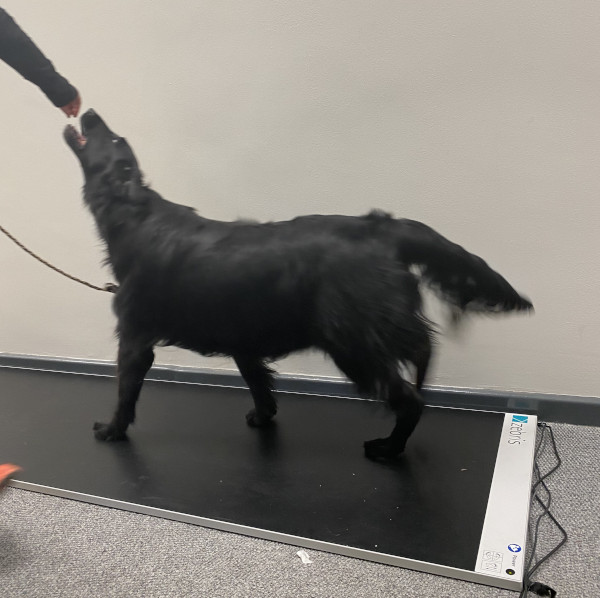
I attended a day of “lab” work centered around the use of a force plate.
A force plate is a sensitive platform embedded in a walkway, that objectively measures the weight a patient places on each leg, in order to diagnose subtle lameness and track their progress during rehab.
Vets (mostly surgeons) have said for years that the weight distribution is not 50-50 between the front and back legs. We’ve said it’s 60% in the front, because the front legs “carry” the head, the neck and the chest. And the back legs mostly “carry” the belly, so that’s only 40% of the weight.
Force plate analysis shows that this is a generalization. We just can’t compare the body shape of a mini Doxie, a Bassett hound and a mastiff.
This is important when we talk about the impact of weight loss and leg amputation.
Weight loss benefits the entire body, and now you understand why it helps the front legs even more, since they “carry” more weight.
The speaker, a physical therapist, also explained that seemingly minor things can change the results of force plate analysis: the position of the pet’s head, a wagging tail, turning the head to get a treat, pulling on the leash, wearing a neck collar rather than a harness, etc.
Bottom line: a force plate is very helpful to diagnose a difficult lameness, and we have a lot more to learn!
How to best treat arthritis pain?
I loved a lecture presented by a surgeon, who reminded us that the source of pain in a patient with arthritis is the LINING of the joint.
Therefore, treatments should target the lining of the joint.
We’ve started to inject various products and medications in our patients’ joints, with excellent results.
We started years ago with:
- stem cells
- PRP (Platelet Rich Plasma), both of which you may have heard of in people.
Now, we also inject:
- collagen (Spryng®)
- steroids (cortisone)
- hyaluronic acid etc.
The results have been very impressive, including in “desperate” cases where nothing else had helped the patient.

When should we use modern arthritis drugs?
Another physical therapist reminded the audience of something surgeons know all-too-well. The newer anti-arthritis medications like Librela® and Solencia® should not be used when a joint is instable. To avoid potentially devastating side-effects, surgery should be recommended first in these patients, specifically to stabilize the joint.
In addition, these drugs should NOT be combined with Non-Steroidal Anti-Inflammatory drugs (NSAIDs), again for fear of potentially disastrous side-effects.
So remember, our current understanding is that there are at least 2 situations when Librela® and Solencia® should not be used:
- with an unstable joint
- with an NSAID
If you would like to learn how we can help your pet with safe surgery and anesthesia, please contact us through www.DrPhilZeltzman.com
Never miss a blog by subscribing here: www.DrPhilZeltzman.com/blog
Phil Zeltzman, DVM, DACVS, CVJ, Fear Free Certified
Dr. Phil Zeltzman is a traveling veterinary surgeon in Pennsylvania & New Jersey. An award-winning author, he loves to share his adventures in practice along with information about vet medicine and surgery that can really help your pets. Dr. Zeltzman specializes in orthopedic, neurologic, cancer, and soft tissue surgeries for dogs, cats, and small exotics. By working with local family vets, he offers the best surgical care, safest anesthesia, and utmost pain management to all his patients. Sign up to get an email when he updates his blog, and follow him on Facebook, too!